Website Redesign for Cybersecurity Consulting Firm RealTime Cyber
Year
2025
Industry
Cyber Security
Company Size
2-10
Service(s)
Webdesign & Webflow Development
Introduction
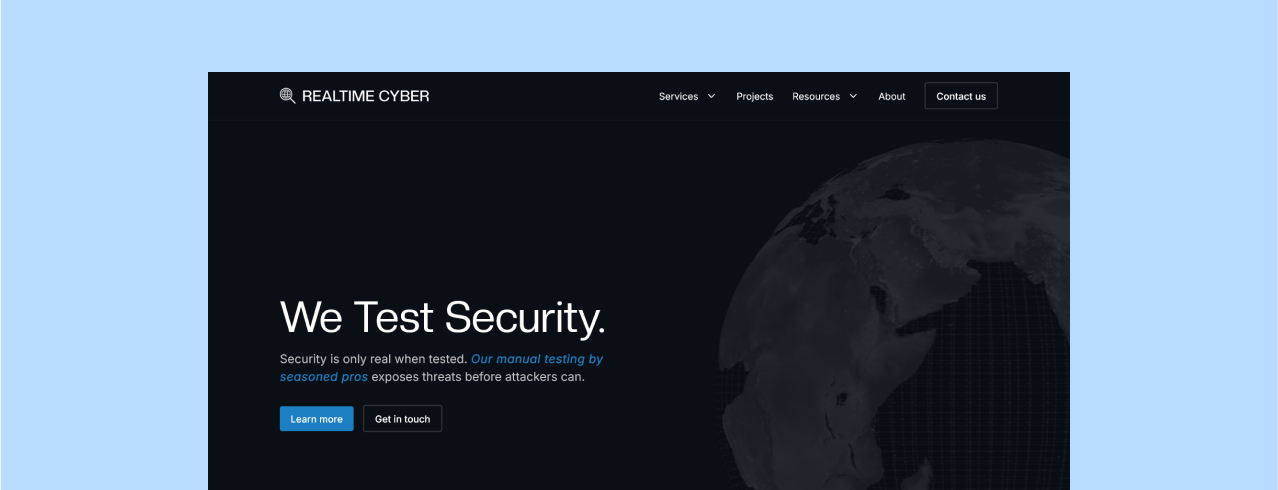
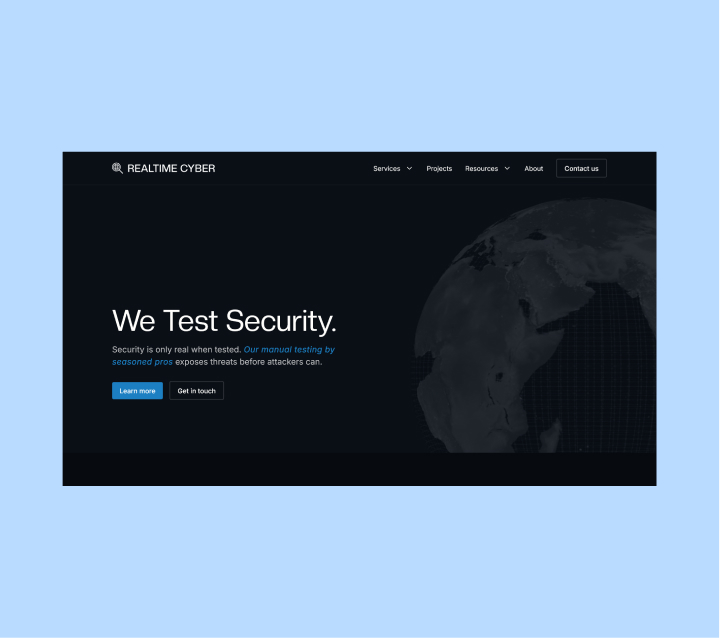
RealTime Cyber approached us with a clear ambition: their existing website no longer matched the level of expertise, reliability, and focus they bring to their clients. The content structure made it difficult for visitors to quickly understand what RealTime Cyber offers, and internal updates were slow and dependent on external support. They were ready for a change that felt sharp, secure, and future-proof.
Situation
As a cybersecurity partner, RealTime Cyber operates in an environment where clarity and trust are non-negotiable. Their previous website didn’t fully support that. Key services were hidden in dense navigation, messaging overlapped or repeated, and there wasn’t a clear path for decision-makers to move from interest to action.Internally, the team found it difficult to evolve the site. Adding new pages, updating cases, or highlighting new focuses required too much technical overhead. The website was no longer a tool for growth, it was something to work around.They needed a new setup that:
- explained their story in a structured, confident way,
- guided different audiences (technical, business, partners) to the right information,
- and could be managed by their own team without friction.
Our Role
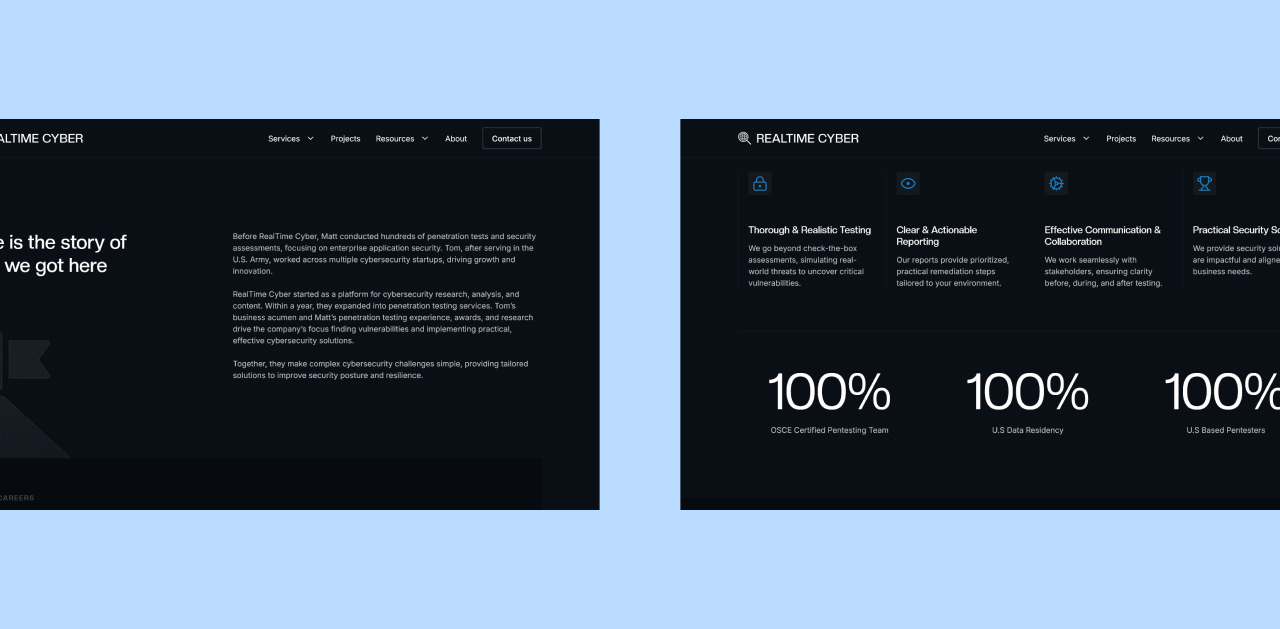
We joined RealTime Cyber as a full partner for the redesign, from the first strategic conversations up to launch and training. Together, we redefined the structure, designed a new visual language, built a scalable Webflow environment, and made sure their team could independently maintain and grow the website.
Our Approach
Rather than jumping straight into visuals, we started by aligning on three essentials:
First, we clarified the narrative: what RealTime Cyber stands for, which services matter most, and how we guide visitors from problem to solution without overwhelming them.
Second, we translated that clarity into structure. We mapped a new sitemap that grouped related services, removed noise, and built logical journeys for different visitor types.
Third, we committed to scalability. Every design and technical decision had to support easy expansion: more pages, deeper content, additional campaigns, without redesigning the system each time. This approach allowed us to move through strategy, design, and development with a shared framework and fewer surprises along the way.
Our solution
UX & structure
We began with a detailed sitemap that re-organised the entire website into clear sections. Redundant or outdated content was removed. Core services and solutions were given a clear position. The result is an information architecture that feels deliberate: visitors can quickly understand who RealTime Cyber is, what they do, and where to go next.
From there, we created a complete wireframe set for all key pages. These weren’t just grey boxes, they already defined content priorities, messaging blocks, proof elements, and interaction patterns. This allowed the team to react early, refine the story, and confirm that the user journeys worked before any visual design was locked in.
Visual direction & UI
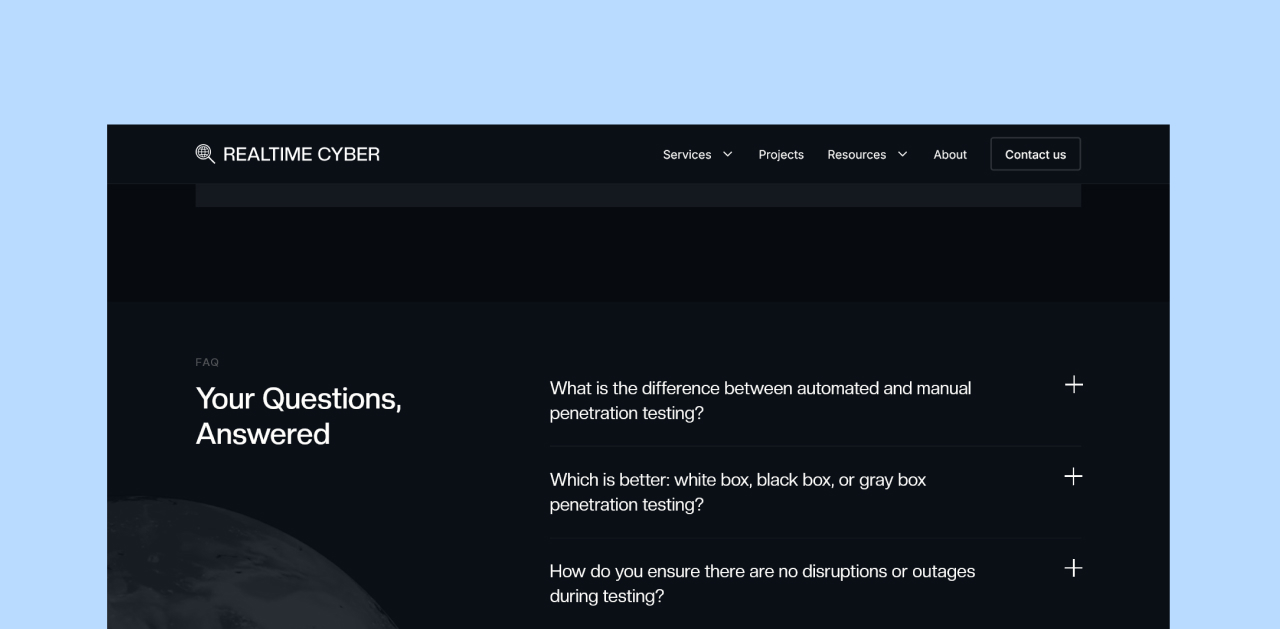
With the structure approved, we explored the visual language: how should a modern cybersecurity partner look and feel online? Together, we moved towards a style that is clean, confident, and precise, but with enough character to stand out.
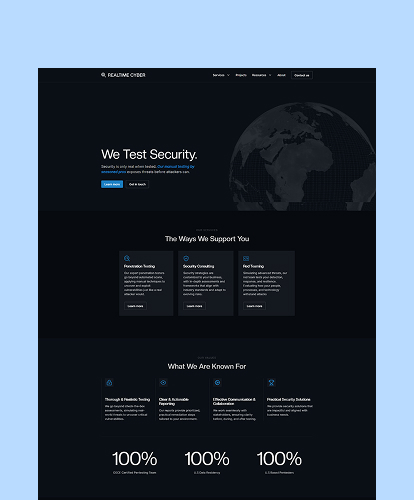
We started with the homepage as the foundation. Once the direction was aligned, we extended the same system across all pages: consistent typography, spacing, colour usage, and components. This consistency is key in a high-trust domain like cybersecurity: every page feels part of one coherent experience.
Design system in Figma
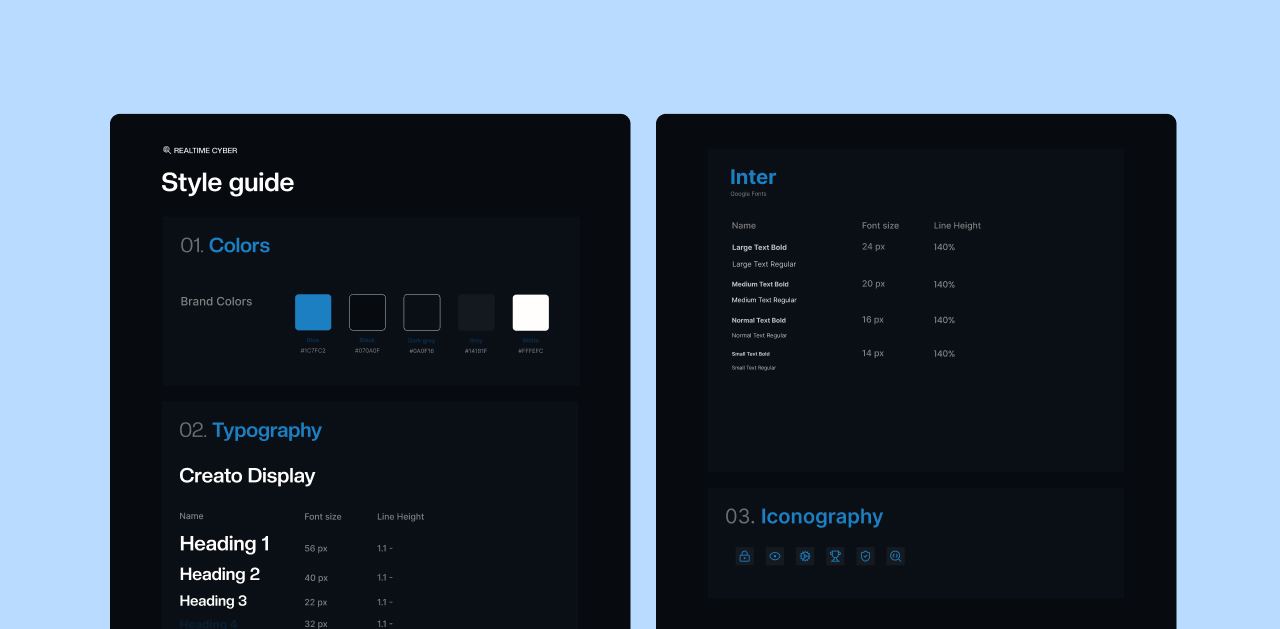
To make the design maintainable, we built a design system in Figma. It includes core components, layout patterns, states, and usage guidelines. For RealTime Cyber, this means future updates don’t start from scratch; new pages can be built from an existing library while staying on-brand and accessible.
Webflow development
We then translated the approved designs into a Webflow build that is as structured under the hood as it appears on the surface.
Layouts are recreated pixel-perfect, responsive behaviour is carefully tuned across all breakpoints, and class naming is logical and consistent. Recurring sections, such as hero layouts, content blocks, and call-to-actions, are implemented as reusable components. This allows RealTime Cyber’s team to spin up new pages by assembling existing building blocks rather than reinventing them.
CMS & content management
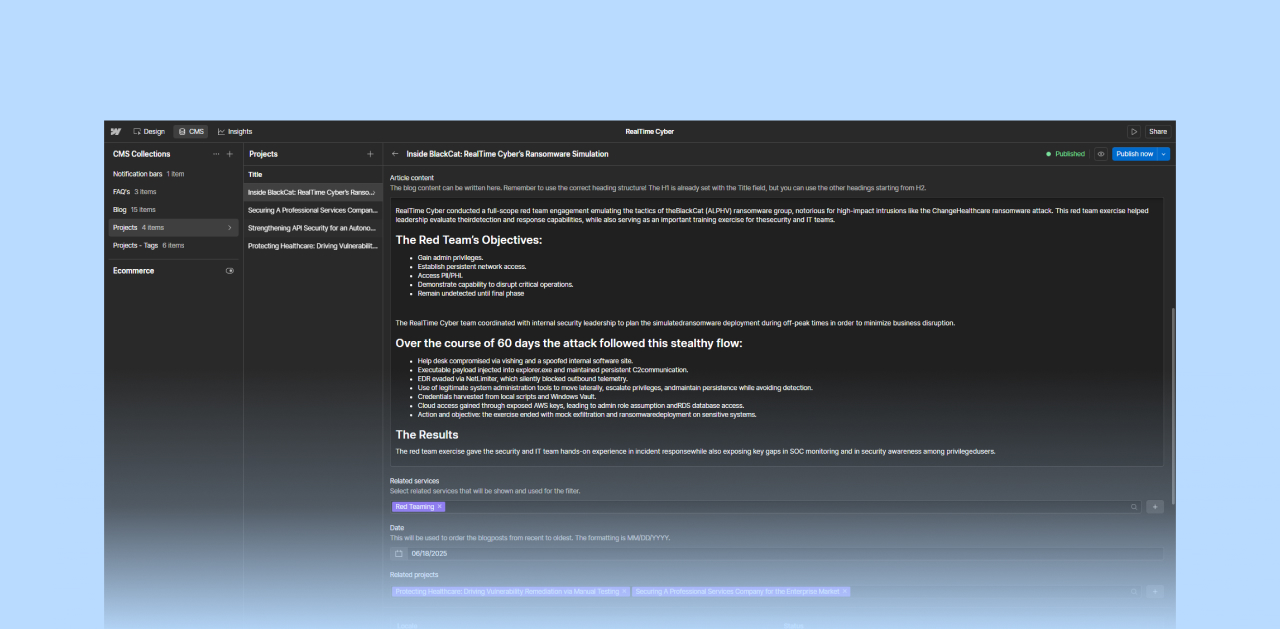
The Webflow CMS was set up to reflect how RealTime Cyber actually works. Collections for case studies, services, and potentially future content types are structured with clear fields and descriptions, so content editors always know where to put what.
This setup reduces dependency on external support. The team can safely update text, add new examples, or highlight a new focus area with confidence that the site will stay consistent.
SEO & performance
Alongside design and build, we addressed the technical foundation.All assets were optimised for performance to keep loading times fast, which is especially important for international visitors and security-conscious audiences. Redirects were configured to ensure that existing backlinks and rankings from the old site were preserved. The new structure, headings, and meta setup follow best practices so search engines can properly understand and index the content.

Launch, training & support
Once everything was tested, layouts, forms, responsiveness, tracking, redirects, we planned the launch together. During a live session, we updated DNS settings and verified that the new site was up and running smoothly.
After go-live, we stayed available for a dedicated test period. Only minor adjustments were needed, confirming the stability of the setup. To close the project, we hosted a live Webflow training for the RealTime Cyber team, walking them through page editing, CMS workflows, and how to work within the component system without breaking consistency.
Results & impact
Decision-makers can now quickly understand their services. The structure supports targeted conversations. The internal team has full control over content and can move faster without waiting on developers for every change.
The measurable impact will only grow over time, but the foundations are in place: a stronger story, a more intuitive experience, a cleaner technical setup, and a website that’s built to evolve with RealTime Cyber rather than hold them back.


Testimonial
Suggested projects