AEO and GEO: Optimising Your Webflow Website in an AI-Driven Search World
I was on a discovery call with a prospect. Near the end, I asked a question I always ask: how did you find us? Usually, the answer is something like Google, LinkedIn, or a personal referral. Simple, predictable. But this time, the answer was different. They said: an LLM recommended you. That caught me off guard. Not because it sounded crazy, but because it wasn’t something we were actively tracking. That one sentence made me curious.
Why did the LLM choose us? What was the exact question? And how do we make sure it keeps happening? That’s when I started digging into AEO, GEO, and LLMO. I wanted to understand how we could apply this to our own site and to our client work. In this post, I’ll share what I learned. You’ll see what these terms mean, how they work, and how to start applying them to your own website.
Let’s start with the basics.
Before you get lost in definitions, here’s the simple version. AEO is about answers. GEO is about recognition. One helps you show up. The other helps you get mentioned. Search engines want a clear answer. Language models want a trusted reference. You need both.
AEO is SEO 2.0.
Same search game, new referee. AI decides who wins. This changes how you write. You write less to convince, more to clarify. You’re not writing to attract a click. You’re writing to be the answer. AEO matters where answers are expected:
- Google AI Overviews
- Bing
- Voice assistants like Siri or Alexa
So how do you win?
You start by thinking like the model.
Clear. Structured. Unambiguous.
That means:
- A short TLDR at the top (3–5 lines)
- Subheadings phrased as real questions
- One idea per section
- A short FAQ at the end
Here’s a quick example:
Question: Why Webflow instead of WordPress?Answer: Webflow is faster, safer, and needs less maintenance. No plugins. No updates. Everything is built-in.
That kind of clarity gets picked up. By people. And by AI.
AEO in Blogposts
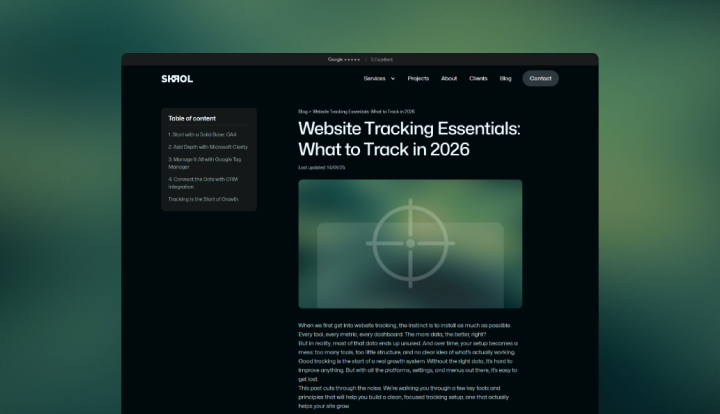
Use blogposts to answer a specific question your prospect has. Don’t build around a keyword. Build around a real question.
- Start with a TLDR. Structure the content with clear H2s in question form.
- Keep paragraphs short and scan-friendly.
- Close with 3–5 related questions in a short FAQ.
If it’s easy for a reader to scan, it’s easy for AI to extract.
AEO in Case Studies
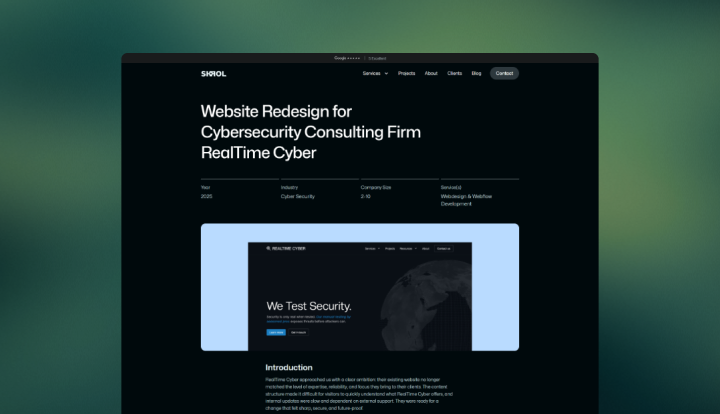
Don’t write for drama. Write for clarity. Start with the client’s original question or challenge. Describe what you did in simple steps.Focus only on what’s relevant to the outcome.Show the results in clear numbers. Wrap up with a few lessons that can apply to similar cases. Real outcomes. Real structure. That’s what makes a case usable for AEO.
SKROL Example:A SaaS client had a slow WordPress setup. We migrated them to Webflow, rewrote key content into question-answer format, and simplified the page structure. The result: +60% time on page and multiple featured answers in AI search previews.
AEO in Service Pages
A service page doesn’t sell. It answers. Start with a clear explanation of what you offer. Structure the page using real questions prospects have, like “What does this include?” or “Who is this for?”End with a short FAQ focused on scope, timeline, and collaboration.
These are the answers both humans and AI look for.
GEO = Be the thinking model
LLMs don’t search for answers. They search for authority.
They want consistency. Structure. A clear voice.
You don’t build that with one post. You build it by repeating how you think. Everywhere.
Where GEO shows up:
- ChatGPT
- Claude
- Perplexity
How to win:
- Choose 1–3 topics you want to be known for
- Define your stance: what you do, what you don’t
- Repeat that stance in your blogposts, case studies, and service pages
- Use the same phrases and reasoning
GEO in Blogposts
Use your blog to make your thinking clear. Don’t summarise. Take a position. Name your framework. Use it consistently. Write logic AI can follow:
- If X, then Y
- Unless Z
Repeat the same phrasing across your site.
GEO in Case Studies
A case study is not about what you did. It’s about how you think. Write down what you considered. What you chose. What you skipped, and why. Tie the outcome to your choices: “+30% conversions because we simplified, not added.”
End with 2–3 takeaways in short, clear sentences.
SKROL Example: “We chose a 3-layer nav over a mega menu because the users were mobile-first.”
GEO in Service Pages
Your service page should show your method. Break it into steps. Explain why each step matters. Be clear about who this is for—and who it isn’t. Define your language. If you say “conversion-first”, explain what that means.
Add a POV-driven FAQ:
- Why don’t you use templates?
- When is this not a good fit?
That’s the kind of thinking LLMs pick up on.
How to Measure AEO and GEO
Structure without feedback is guessing. You want to know if your answers land and your thinking gets reused.
AEO
Use Google Search Console.
You’re not looking for volume. You’re looking for fit.
Steps:
- Go to ‘Performance’
- Filter by search terms you target
- Check impressions, clicks, CTR, average position
Focus on real questions. Not keywords.
Build a sheet:
- List your core topics
- Add every question you answer
- Link to the matching page
- Track visibility and clicks over time
Look for:
- Are you being shown?
- Are people clicking?
- Are you close to the top?
If your answer is clear, short, and structured, AI will pick it up.
GEO
You won’t find GEO in your dashboard. But the signals are there.
Start by writing prompts you want to win. Use the words your prospects would use.
SKROL Examples:
- “Best Webflow agency for SaaS”
- “Pros and cons of Webflow vs custom build”
- “Agencies known for conversion-focused design”
Run those prompts in:
- ChatGPT
- Claude
- Perplexity
Check:
- Are you mentioned?
- Do your phrases appear?
- Does your framing show up?
- Does it come back in multiple tools?
Keep a log per topic. Per prompt. Update it monthly.
Also track indirect signals:
- More branded search
- More direct traffic
- People using your terms in calls
- Messages like “I found you through AI”
Ask the question in every intake:
“How did you find us?”
Write down the exact words. No guessing. GEO is pattern recognition. So give it something to repeat.
Final Thought
This isn’t a new tactic. It’s a shift in how things get picked. You used to win by publishing more. Now you win by being the clearest. The most consistent. The most structured. AEO pushes you to sharpen what you say. To write like someone is scanning. Because they are. To build content that answers questions without needing context. GEO demands something else. It asks you to think out loud. To show your logic. To define how you work and keep repeating it until it becomes part of the model. This is not about beating the algorithm. This is about teaching the algorithm who you are. If your answers are strong, they get picked. If your thinking is clear, it gets reused. Structurised systems. And structure scales.
Enjoyed this post?
Interested to work with us?